Surgery for Brain Tumors

For many patients with a brain tumor, surgery is often the first line of treatment. Depending on the type of tumor you have, it may be the only treatment you need.

We understand that the prospect of undergoing surgery on your brain can be distressing. When you come to Siteman, you will be in safe, expert hands.

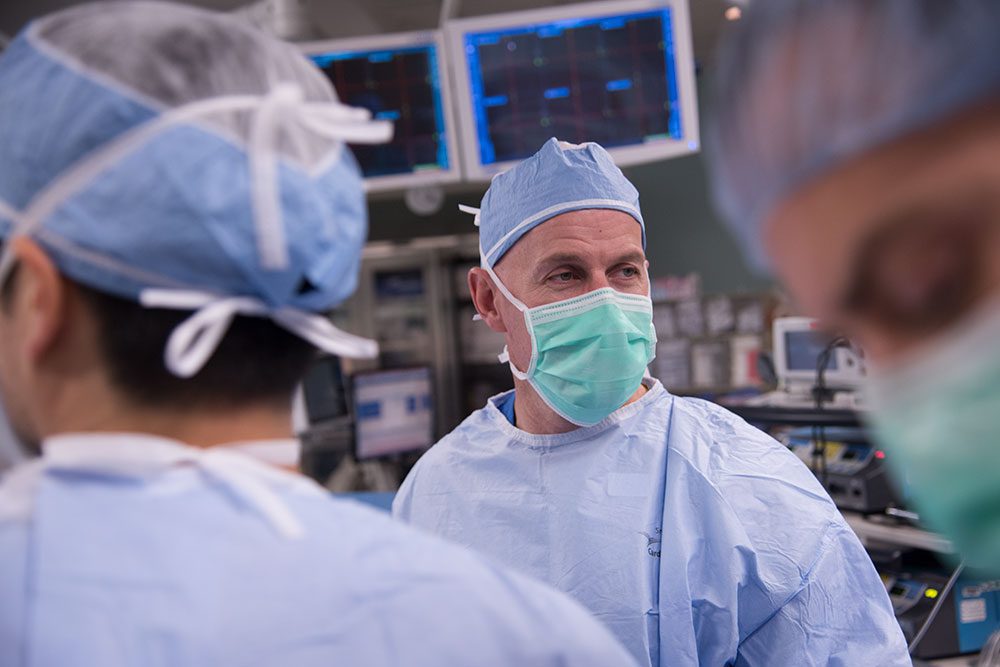
Our WashU Medicine neurosurgeons use advanced technologies and innovative techniques to bring their patients the best results possible. Our neurosurgeons are national leaders in performing image-guided and minimally invasive procedures that minimize tissue injury and pose fewer risks to their patients. At Siteman, our team will work to find a plan for tumors that other centers have deemed inoperable.

How could brain tumor surgery help me?

Brain tumor surgery can serve a number of different purposes, depending on the type of tumor you have.

In patients with benign or low-grade tumors, surgery may be enough to eliminate the tumor and improve the patient’s health. These tumors are slow-growing and less likely to recur, so further treatment may not be necessary.

In patients with malignant tumors, such as glioblastomas, the goals of surgery are different. Malignant tumors are fast-growing, difficult to remove entirely because they are infiltrative by nature, and almost always recur, so surgery alone cannot resolve them.

However, patients with malignant tumors can still benefit from having even a portion of their tumor removed. First, surgery provides biopsy material for a definitive diagnosis, which at Siteman, includes comprehensive molecular characterization, which positions our patients for clinical trial opportunities. Second, surgical resection can relieve symptoms caused by the tumor, helping patients to feel better. Finally, even with the most aggressive brain cancers, a growing body of literature—some of which was generated by Siteman investigators—indicates that removing as much tumor as possible from the beginning significantly improves patient outcomes. This may be because smaller tumors are easier to treat with radiation therapy and chemotherapy, and thus, undergoing surgery can make these additional treatments more effective.

What is a craniotomy?

If you have been diagnosed with a malignant or benign brain tumor, your team has likely recommended a craniotomy. A craniotomy is a kind of surgery where surgeons make an opening in the skull so that they can be closer to the tumor in order to remove it. In the final stages of the craniotomy, a patient’s skull is put back into place so that the bones can heal.  

Patients at Siteman can expect their surgeon to use precision instruments during their craniotomy to promote their safety during the procedure and to support their recovery after it is done. Surgeons also use different techniques and approaches, depending on each patient’s unique diagnosis.  

Awake craniotomy

An awake craniotomy is a specialized kind of craniotomy surgery. An awake craniotomy can be recommended when a patient has a brain tumor in a part of the brain that controls movement and speech abilities. It is a kind of surgery that helps protect patients’ abilities during the procedure by waking them up and asking them to do simple tasks during the surgery. 

Siteman uses a multi-disciplinary team in the surgical suite to monitor their patient’s verbal, neurological and fine motor responses to prompts. Patients may be asked: 

  • to name objects shown to them on an iPad,  
  • to repeat sentences,  
  • to tell short stories, like future plans,  
  • to count numbers, etc. 

In-the-moment responses and the quality of a patient’s answer informs surgeons of areas to avoid to preserve speech and motor areas of the brain while they remove as much of the tumor as they can. When the surgeon is confident they have the information they need from a patient, the patient is sedated again until the surgery is done. 

Patients considering the surgeons’ recommendation of an awake craniotomy often report feeling afraid. The idea of being awake and aware during an awake craniotomy can be a scary, overwhelming thought. But the idea is often more distressing than the actual surgery. During surgery, patients do not feel pain even when they are awake. The brain is the only organ that cannot feel pain and our surgical team uses anesthesia for the scalp and skull.  

At Siteman, your WashU Medicine neurosurgeons have conducted awake craniotomies several times each month. Be sure to speak to them about any of your questions or concerns, and they will do their best to explain so you understand what to expect. 

Image-guided surgery

Brain tumor surgery poses unique challenges compared to surgery for tumors in other parts of the body. Every millimeter of brain tissue is vital, and removing or damaging normal brain could have a major impact on a patient’s quality of life. Neurosurgeons must work delicately, extracting as much of the tumor as possible while disturbing the normal brain as little as possible.

Because of the complex nature of the brain, it can often be difficult for neurosurgeons to remove tumors in their entirety. WashU Medicine neurosurgeons at Siteman use several leading-edge technologies and techniques to help them “see” tumor cells that have been left behind and remove them safely.

Advanced pre-operative brain mapping and imaging

Siteman neurosurgeons are unique in the world for utilizing cutting-edge MRI sequences performed before the operation to map out vital areas of the brain that must be avoided during surgery. In addition to using neuronavigation—“GPS” for the brain—and white matter tractography to map out the tumor and the important functional wiring of the brain, we have pioneered the use of resting state functional MRI to pinpoint the critical areas of a patient’s brain as an additional layer of safety during surgery.

Intraoperative MRI

Intraoperative MRIs are magnetic resonance imaging scans conducted during a surgical procedure. They offer a number of advantages for surgeons and patients.

Surgeons perform intraoperative MRIs in order to track the changing position and shape of the tumor as they remove it. Because MRI maps of the tumor conducted prior to surgery become unhelpful after surgeons have begun to operate, intraoperative imaging allows them to make immediate adjustments as needed.

Patients who receive intraoperative MRIs benefit from having more of their tumor removed. They may not need any follow-up surgeries to extract portions of the tumor that were missed during the initial procedure.

Siteman is a leader in performing intraoperative MRIs and WashU Medicine neurosurgeons have one of the largest experiences with intraoperative MRI in the nation. We use mobile MRI machines that can be moved into the operating room during surgery, so the patient doesn’t have to be taken to another location.

Fluorescence-guided surgery

In some cases, WashU Medicine neurosurgeons at Siteman will use fluorescent dyes to illuminate tumor cells during surgery. Patients are asked to drink fluid or take a pill containing a fluorescent dye several hours before their procedure. Because cancer cells retain the dye more than normal cells, they will turn bright pink, or fluoresce, when viewed under a microscope. This helps the surgeon to remove even more of the cancer cells in an efficient manner.

Fluorescence is typically used during procedures to remove malignant tumors.

Minimally invasive surgery

The WashU Medicine neurosurgeons at Siteman conduct minimally invasive procedures whenever possible. There are several different approaches, including:

Keyhole surgery

Keyhole surgeries do not require a large opening in the skull. Instead, surgeons drill a small hole and perform the procedure with the assistance of tiny cameras and other tools which allow them to see and work inside the brain. The incision is often small enough to be closed with very few stitches and can be placed in discreet locations allowing for excellent cosmetic results.

Transsphenoidal surgery

This procedure is used to extract pituitary tumors or tumors of the anterior skull base. It doesn’t even require a visible incision: instead, the tumor is removed through the sphenoid sinus and out the nose. The surgeons use tiny cameras called endoscopes to visualize the tumor and operate safely. For this reason, the procedure is sometimes referred to as an “endonasal endoscopy.”

MRI-guided laser interstitial thermal therapy (LITT)

Some tumors are located too deep in the brain to be removed effectively with open surgery. Today, neurosurgeons at Washington University are using a laser probe to treat these tumors and bring patients relief.

During this procedure, known as MRI-guided laser interstitial thermal therapy, the surgical team will drill a tiny hole in the patient’s skull. They will then use a robotic arm and MRI-imaging to steer the laser probe through the brain and into the tumor. When the probe has been placed inside the tumor, it uses intense heat to kill tumor cells.

Laser interstitial thermal therapy can be used to treat several different types of tumors, including gliomas, metastatic tumors, and meningiomas.

Transorbital neuroendoscopic surgery (TONES)

Transorbital neuroendoscopic surgery, called TONES, is a kind of minimally invasive brain surgery for patients who have tumors in the base of their brain, the frontal lobe, or temporal lobe. The procedure allows patients to have their tumor removed using neuroendoscopic tools and without the need to have a portion of their skull removed. Instead, Siteman surgeons use the eye socket, or orbit, as the starting point for surgery.  

WashU Medicine surgeons within The Brain Tumor Center are experts at the TONES technique and may recommend it to patients who have tumors at the base of their skull, brain metastases, or gliomas.  


How does TONES benefit patients?

Before the TONES technique was developed, surgeries to remove tumors in the skull base, the frontal and temporal lobes of the brain have been difficult for patients. Surgeries were long and the recovery times were significant.    

The TONES technique has improved patient care. The approach makes surgery minimally invasive through using: 

  • A natural opening into the skull, using the eye socket (called the orbital socket)  
  • A small, endoscope with a camera, light, and tools for removing the tumor. 

During transorbital neuroendoscopic surgery, patients are under sedation for shorter periods of time and less of the body is impacted. Surgeons can leave the skull intact and more of the brain, even tissue around the tumor, can be left alone.  

On average, TONES patients experience:  

  • Shorter recovery times 
  • Fewer complications from their surgery 
  • Little to no change to their appearance  
  • Minimal pain  
  • Less healing and internal scaring, making future procedures possible  

Will I need to have my hair shaved before the surgery?

At Siteman, neurosurgeons understand that patients tend to recover more quickly when they are comfortable and confident in their appearance. They make it a priority to either avoid shaving their patients’ hair or perform only a minimal shave.

WashU Medicine neurosurgeons also protect their patients’ hair by conducting minimally invasive procedures and finding creative ways to disguise incisions. Your surgeon will speak with you about your options.

What are the risks of brain tumor surgery?

As with any surgical procedure, surgery to remove a brain or spine tumor can pose a number of risks to the patient. Individuals who undergo surgery of any kind are susceptible to problems caused by anesthesia, blood loss, or infection.

In addition, patients who undergo brain surgery may be at risk for serious complications caused by brain injury, brain swelling, and stroke. They also may experience seizures following the procedure.

At Siteman, your care team will carefully monitor you during your recovery, both in and out of the hospital. They will administer medications to control or prevent side effects. You may receive corticosteroids to control swelling.

What is the recovery process like for brain tumor surgery?

The recovery process for brain or spine tumor surgery depends largely on the patient’s tumor type. Patients who undergo endoscopic surgery for a pituitary tumor, for example, are usually able to leave the hospital within 1-3 days of the procedure. Even patients who undergo a craniotomy for a glioblastoma or other tumor may leave the hospital in as few as 2-3 days. Some tumor patients do have a more prolonged hospital stay.

Some patients will need physical therapy and other supportive care following their surgery. At Barnes-Jewish Hospital, our exceptional physical therapists will diligently work with you to help you regain your strength and quality of life as much as possible.