Back to All News

Tumor Markers May Help Doctors Decide Which Head and Neck Cancer Patients Need Immunotherapy Before Surgery

|
Immunotherapy for head and neck cancer. Shown is an artist's rendering of immune cells (light blue) attacking a cancer cell.

WashU Medicine physician-scientists at Siteman Cancer Center identify a promising way to help guide immunotherapy treatment decisions and enhance patient care

Building upon more than a decade of investigator-initiated clinical trials at Siteman Cancer Center, based at Barnes-Jewish Hospital and WashU Medicine, researchers have identified a malignant cell biomarker that may predict which patients will respond to the immunotherapy drug pembrolizumab, known commercially as Keytruda, for the treatment of resectable locally advanced head and neck squamous cell carcinoma (LA-HNSCC).

The research, published March 31 in Cell Reports Medicine, is the latest discovery from one of the nation’s leading head and neck tumor centers, the Robert Ebert and Greg Stubblefield Head and Neck Tumor Center at Siteman Cancer Center. The findings point to a cell surface protein, major histocompatibility complex class II (MHC-II), as the tumor marker that may help guide treatment decisions. It is typically expressed on immune cells and is important for activating immune responses in the body.

In the study, the researchers found that malignant cells expressing MHC-II and interferon response genes respond better to pembrolizumab administered before surgery, suggesting that a malignant-interferon (IFN)/MHC-II program could be developed into a genomic test to stratify patients into those who should proceed with immunotherapy before surgery and those who should proceed directly to surgery and not be given immunotherapy beforehand.

“Patients with advanced head and neck cancer often undergo immunotherapy prior to and after surgery,” said Sidharth V. Puram, MD, PhD, the Lindburg Professor of Otolaryngology and chair of the Department of Otolaryngology — Head & Neck Surgery at WashU Medicine and co-director of the Robert Ebert and Greg Stubblefield Head and Neck Tumor Center at Siteman Cancer Center. “The use of immunotherapy drugs, however, means that surgery is delayed by as much as eight to 10 weeks. If we can determine which patients are more likely to benefit from immunotherapy and which ones should go straight to surgery, we can potentially improve overall outcomes for our patients. We think that’s what (IFN)/MHC-II can do: predict how well patients will have a tumor response to immunotherapy.”

Puram is the corresponding author of the study. Co-senior authors are Douglas R. Adkins, MD, director of the Section of Head and Neck and Thyroid Medical Oncology in the Division of Medical Oncology at WashU Medicine and co-director of the Robert Ebert and Greg Stubblefield Head and Neck Tumor Center at Siteman; Ravindra Uppaluri, MD, PhD, director of Head and Neck Surgical Oncology at Dana-Farber Cancer Institute; and Itay Tirosh, PhD, senior scientist in the Department of Molecular Biology at the Weizmann Institute of Science in Israel.

WashU Medicine researchers already have defined a new standard for the treatment for resectable LA-HNSCC in adults. In the pivotal global KEYNOTE-689 Phase 3 clinical trial, published in the New England Journal of Medicinein June 2025 and co-led by Adkins and Uppaluri, researchers found that the administration of pembrolizumab before and after surgery combined with adjuvant (chemo) radiation therapy resulted in tumor cell death in the surgical specimen and significantly improved the event-free survival (EFS) for these patients.

Perioperative pembrolizumab was approved by the FDA in June 2025 and changed the standard treatment pathway for patients with LA-HNSCC.

“The KEYNOTE-689 trial was built on the favorable results of investigator-initiated trial testing of perioperative pembrolizumab that was developed and conducted at WashU Medicine (with participating sites at the Dana-Farber Cancer Institute and Memorial Sloan Kettering Cancer Center),” Adkins said. “In these trials, administration of pembrolizumab before surgery resulted in evidence of tumor cell death in the surgical specimen in up to 50% of patients, a finding linked to better EFS. However, a biomarker was needed that could predict which patients benefited from pembrolizumab before the immunotherapy drug was given. Tumor PD-L1 protein expression does predict potential benefit with pembrolizumab in these patients; however, this test is a very weak predictive biomarker. Predictive biomarkers with stronger links to benefit with pembrolizumab are needed to select patients a priori who may or may not benefit from pembrolizumab before and after surgery.”

To understand the underlying biology and what might drive tumor responses to immunotherapy, researchers used single-cell RNA-sequencing on tissue samples from 16 HNSCC patients, both pre- and post-neoadjuvant pembrolizumab treatment, who were enrolled

in the phase 2 trials that represent the predecessors to KEYNOTE-689.

“Single cell approaches allowed us to profile the individual malignant cells and understand the specific genes expressed and how they change with immunotherapy,” Puram said. “Surprisingly, we found a subpopulation of malignant cells that were defined by MHC-II and interferon response genes that predicted immunotherapy response.”

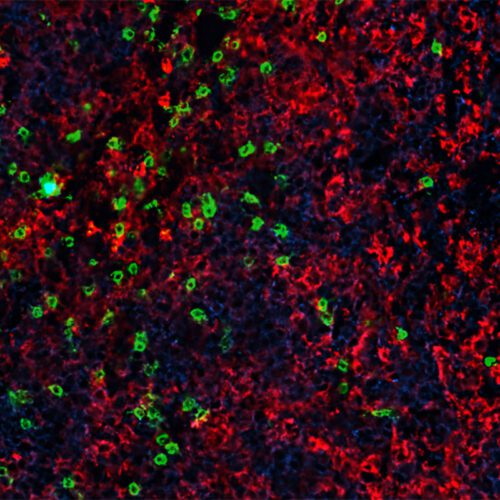
The researchers believe that MHC-II and interferon expression by malignant cells reflects engagement of immune cells with T cells, which are positioned to kill the cancer but have been “turned off” — a state called T-cell exhaustion. Based on spatial techniques, they hypothesize that immunotherapy drugs like pembrolizumab “wake up” these T cells, with MHC-II and interferon identifying which tumors might be poised to then respond to the immunotherapy.

“These results suggest that for the first time, a clinically available strong predictive biomarker may become available to clinicians that can be used to decide whether to include perioperative pembrolizumab before and after surgery and adjuvant therapy for the treatment of patients with LA-HNSCC,” Adkins said. “This will be an important milestone to achieve for our patients.”

“What we’ve demonstrated is the importance of malignant cell states for immunotherapy response,” Puram added. “After more studies with more patients, we envision that a simple test could be developed that tells us if a patient expresses (IFN)/MHC-II and therefore would benefit from immunotherapy. We think this is a significant finding as we continuously try to predict which patients will respond and how to make treatments more effective.”

Historical Clinical and Research Breakthroughs

Siteman Cancer Center has a long history of improving outcomes and driving novel research into head and neck cancers. The WashU Medicine Department of Otolaryngology is among the top 10 recipients of NIH research funding among otolaryngology departments. Within the Robert Ebert and Greg Stubblefield Head and Neck Tumor Center, investigators and physician-scientists across a multidisciplinary team of otolaryngology, medical oncology and radiation oncology specialists oversee one of the largest basic, translational and clinical research portfolios in the country. In addition to paradigm-changing clinical trials such as the KEYNOTE-689 trials, researchers at the center have pioneered advanced reconstructive techniques and new therapies with radiation and chemotherapy, as well as immunotherapies and targeted therapies for head and neck cancers.

Learn more